Status Reporting Exemplar
Status Reporting is 99% Communication, 1% Formatting
I’ve worn several hats across my career—including Account Manager, Project Manager, Program Manager, and Product Manager. I’ll let you decide which “P” I’m wearing here.
What I’ve learned across all of them is this: effective status reporting is not about templates—it’s a mechanism of communication.
Below is a status reporting artifact I commonly start with when engaging in complex, transformational work that requires communication across audiences ranging from delivery teams to executives. I’ve included it here not as a template to replicate, but as an example of how structure, framing, and intent combine to drive alignment, confidence, and—most importantly—meaningful action toward meaningful objectives.
Example: Weekly Executive Status Dashboard
Designed for rapid executive consumption while maintaining delivery-level fidelity.
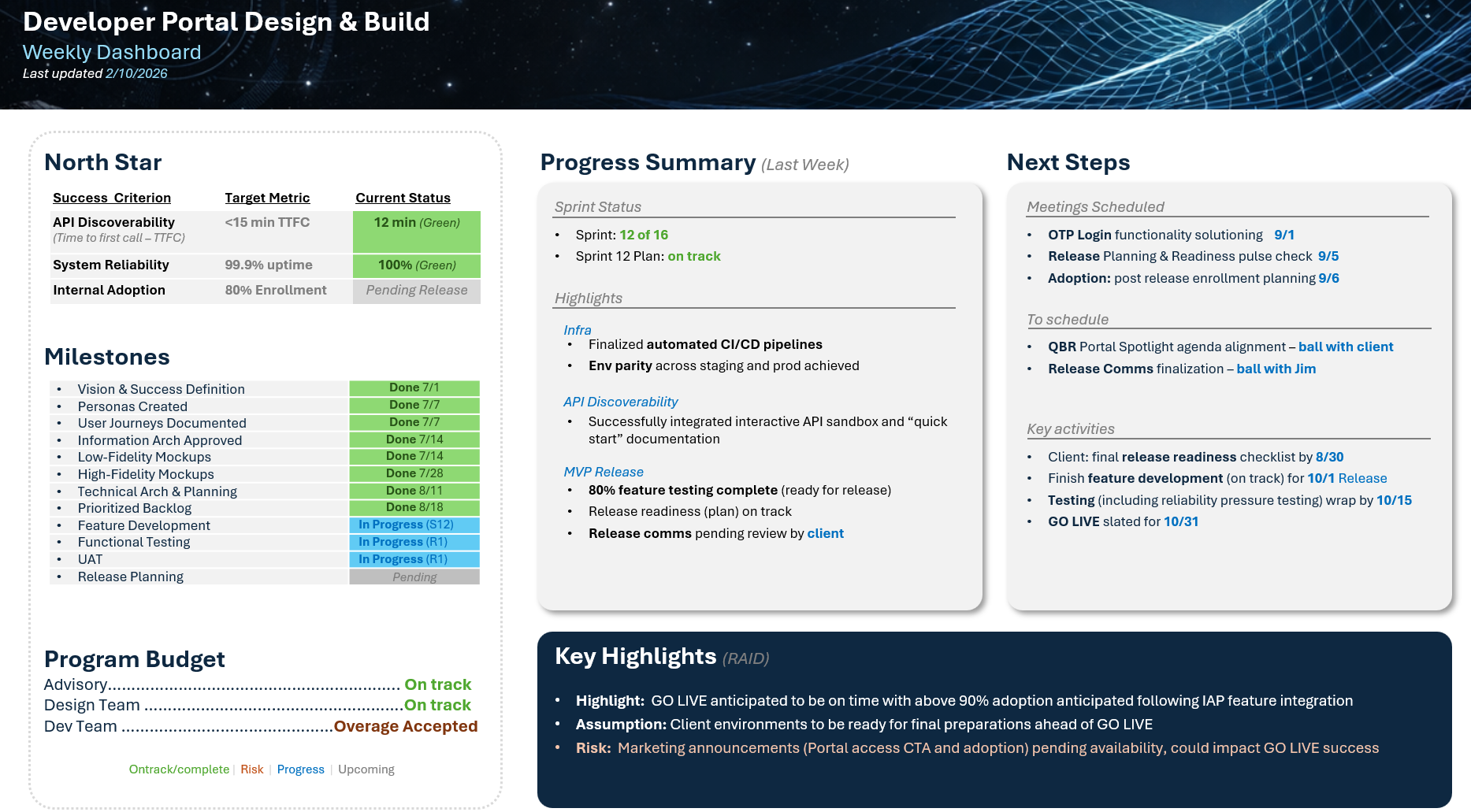
A Drill-Down on Effective Status Communication
What a Status Report Really Is—and Why It Matters
It’s Friday morning. You need to publish the weekly status report for your active initiative. You fill it out and surface it to your team.
Crickets.
There are usually two dynamics at play. The first is cultural: the team doesn’t view the status as important, assumes it’s someone else’s responsibility, and disengages. The second is structural: the report itself is dry, unfocused, or unproductive.
A status report should be treated as a deliberate demonstration of progress, with crisp calls to action. Any stakeholder—especially one with limited time—should be able to review it quickly and feel confidence in the trajectory being conveyed.
When done well, status reporting becomes the backbone for conversations around retention, expansion, reducing churn, and highlighting delivered value. If you’re off course in those areas, you’ll often feel it first in your communications.
Treat the status report as both an internal temperature check and the gold-standard communication anchor with your clients.
The Four Components of a Gold-Standard Status Report
High-Level Framing
Before listing deliverables, establish the shape of the work. What initiative is being updated? What outcomes matter? What milestones define success?
This primes stakeholders to interpret everything that follows in the correct context—and ensures the update can stand on its own when referenced elsewhere.
Progress Recap
On a weekly cadence, focus on what moved—and why it matters to the client. Highlight progress through the lens of outcomes, not activity.
The core question to answer:
Are we closer to the success we scoped?
Next Steps
Make the immediate path forward explicit. What’s planned, what’s pending, and what decisions or actions are required—regardless of whether they align neatly to meetings or sprints.
RAID (with Highlights)
Risks, Assumptions, Issues, and Dependencies remain essential. I often include Highlights either as a wrapper or as a distinct callout.
For time-constrained executives, this section often is the report—so it must be intentional.
The Core Tenets of Effective Status Communication (THIS)
T — Triage the Messaging
Don’t stack-rank information indiscriminately. Design reports so critical information stands on its own, with supporting detail available only as needed.
Think: scan first, dive second.
H — How You Gather and Deliver Matters
Timing, channel, and clarity all shape perception. A well-crafted update delivered at the wrong moment can still fail.
Great communicators optimize for how information is consumed, not just what is shared. Send updates at a time that helps your audience, lead with essential information, and make it easy to extract what matters.
I — Invoke Action
A simple litmus test: are the next steps unmistakable?
A strong status report should either reinforce confidence through progress or clearly articulate what—or who—is needed to maintain momentum.
S — Shorten Relentlessly
If a status cannot be conveyed on a single slide or in a single elevator ride, clarity is likely missing.
This isn’t about oversimplifying—it’s about ensuring everyone understands what matters most right now. If everything feels new and urgent, it may signal misalignment, lack of adoption, or insufficient feedback loops.
Why This Matters
When done well, status reporting becomes the primary trust-building mechanism between teams and stakeholders.
When done poorly, it becomes noise.